GRC and InfoSec
- Use your existing ISMS as the base.
- Connect AI requirements to one control estate.
- Keep AI and security risk comparable.
Instant indexed PDF eBook download 🔒 Secure checkout via Lemon Squeezy 7-day refund policy Price includes UK VAT No access restrictions. Use across your internal team. Written for audit-oriented implementation work
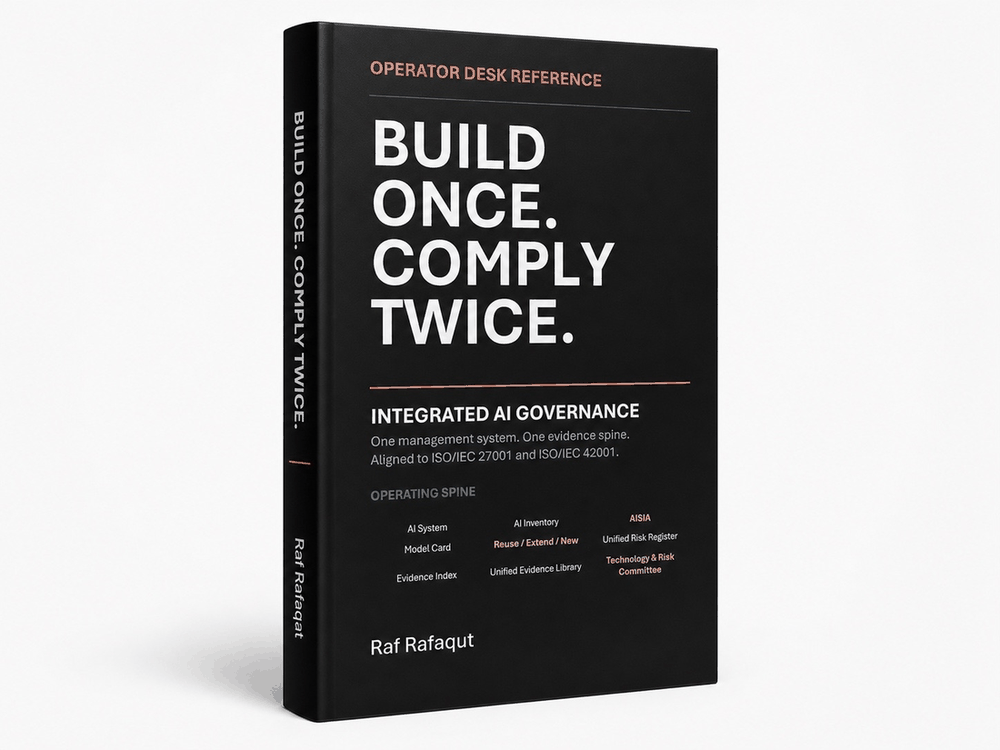
Most organisations responding to ISO/IEC 42001 build a second governance layer alongside their ISMS. Doubled overhead, fragmented evidence, a structure that fails under audit. This book gives you the integrated operating model that extends what you already have.
Instant PDF download. No app, no account, no wait. Open it in any PDF reader on any device.
The PDF and paperback include a complete back-of-book index. The Kindle format does not - making it the weakest option for reference work.
Appendix templates designed to be printed and used alongside live implementation work. Two bonus tools included.
The instinct
When ISO/IEC 42001 lands on the roadmap, the default response is to build AI governance alongside the ISMS. A second register. A new policy set. A parallel committee. A separate evidence approach. It looks thorough. It is not defensible.
The cost
Parallel governance structures fragment ownership, create evidence gaps, and produce two audit trails that contradict each other. When an auditor asks who owns a decision, neither structure gives a clean answer. The result is doubled overhead and a system that fails exactly when you need it to hold.
The integrated path
Reuse your ISMS spine. Extend only where AI creates a genuine new governance need. Produce one evidence trail, one risk register, one ownership model. Build Once. Comply Twice. That is what this book teaches.
| Day | Action | Output you should hold |
|---|---|---|
| 1 | Name the proof-slice AI systems and assign one named AI Owner. | Proof-slice list; AI Owner assignment log. |
| 2 | Create or update the AI Inventory entries. | AI system ID, status, supplier indicator, approved-use statement. |
| 3-4 | Write approved-use and prohibited-use boundaries. | Approved use; prohibited use; reassessment triggers. |
| 5-7 | Run AISIA triage or full AISIA. | AISIA record with tier rationale and approval path. |
| 8-9 | Record the material decision. | Decision Log entry with trigger, authority and evidence links. |
First 30 days action sequence for integrated AI governance
Your first 30 days. One AI system. Fully governed.
A day-by-day action sequence to implement one governed AI system from scope to evidence - with built-in stop rules so you know when to pause before scaling. The goal is not a populated register. It is one AI system traceable from scope to evidence that you can put in front of an auditor.
| Case / Source | What happened |
|---|---|
| Moffatt v Air Canada 2024 BCCRT 149 | A website chatbot gave wrong bereavement-fare information. |
| EEOC v iTutorGroup 2023 settlement | Hiring software automatically rejected applicants because of age. |
| FTC v Rite Aid 2023 order | AI facial recognition used for surveillance without reasonable safeguards. |
| FTC v IntelliVision 2025 final order | Unsupported claims about facial-recognition accuracy and bias. |
External pressure mapped to the Build Once. Comply Twice. control spine
Real enforcement cases. Mapped to your controls.
The cases exist. The patterns are clear. This sheet maps real AI enforcement actions and regulatory pressure points to the controls in this book. When a sponsor or committee asks what failure your governance is preventing, this gives you a specific, evidenced answer - not a general one.
Three formats. One clear winner for implementation work.
|
Best value
Direct eBook£17.99 |
Amazon Kindle See Amazon |
Amazon Paperback See Amazon |
|
|---|---|---|---|
| Full back-of-book index | ✓ | Not included | ✓ |
| No dedicated reader app required | ✓ | Not included | ✓ |
| 30-Day Implementation Quick-Start Card | ✓ | Not included | Not included |
| Regulatory & Enforcement Reference Sheet | ✓ | Not included | Not included |
| Instant digital access | ✓ | ✓ | Not included |
| Searchable and device-portable | ✓ | ✓ | Not included |
A desk reference without an index means navigating by memory. The PDF edition includes a complete back-of-book index - every key term, control, artefact and concept indexed to the page. If you use this book in live implementation or audit work, you will use the index constantly. The Kindle format does not include it - a significant omission for a reference book. If you read on screen, the PDF is the only digital format with a proper index.
Open it alongside a live document without switching apps or reader software. Print the appendix templates and use them at your desk. Annotate your copy. Share a single page with a colleague. Drop it in a shared drive for the team. No ecosystem lock-in, no device restriction, no account required to access your own purchase. For a book designed to sit beside real implementation work, that matters.
The book gives you one route of record for integrated AI governance: scope, ownership, AISIA, Model Card, Unified Risk Register, Evidence Index and supplier assurance.

The integrated operating spine
Use the book when you need decisions, owners and evidence to hold under real operational pressure.
Twelve chapters, worked examples, appendix templates, glossary and references. Use it end-to-end the first time. Use it selectively when a live question needs an answer. Every chapter closes with a concrete output list and named evidence artefacts - so you always know what to retain.
| Introduction | The integrated operating model | The route before the detail starts. |
| Chapter 1 | The Duplication Trap | Why bolt-on AI governance fails and what it costs. |
| Chapter 2 | What ISO/IEC 42001 Is Really Asking For | Translate management-system requirements into live controls. |
| Chapter 3 | AI System Scope | Inclusion logic for embedded, supplier and borderline AI systems. |
| Chapter 4 | AISIA - Proportionate Impact Assessment | Tiering, approval, conditions and reassessment triggers. |
| Chapter 5 | Governance Authority and Escalation | AI Owners, Decision Log, escalation route and committee boundary. |
| Chapter 6 | Reuse. Extend. New. | A classification method for integrating ISO/IEC 27001 and ISO/IEC 42001. |
| Chapter 7 | The Unified Evidence Spine and Retrieval | Evidence Index, Unified Evidence Library and retrieval testing. |
| Chapter 8 | Unified AI & Security Risk System | One register for material AI and security risk treatment. |
| Chapter 9 | Model Cards and Transparency in Practice | Approved use, prohibited use, limitations and live evidence links. |
| Chapter 10 | Responsible Use and Ethics Gates | Gate decisions that approve, condition, defer, reject or retire use. |
| Chapter 11 | Supplier AI and Embedded AI Assurance | Supplier opacity, renewal, embedded features and change triggers. |
| Chapter 12 | Implementation Roadmap | Proof slice, phase model, stop rules and scale decision. |
| Closing Note | What This Changes in Practice | The practical shift the integrated model creates under real operating pressure. |
| Appendix | Worked Examples and Templates | Evidence patterns, completed artefact templates and gap-logging structures for live use. |
| Glossary | Terminology Reference | Locked term definitions to prevent synonym drift across the operating model. |
Free preview
The free preview includes the Preface and Chapter 1 - The Duplication Trap. Enough to know whether the book is written at the right level for your work, and whether the integrated operating model is what you need.
PDF - no email required
Raf Rafaqut is an ISO/IEC 42001 trained Lead Auditor with an MSc in Data Analytics and an AI Programme background from Saïd Business School, University of Oxford. He writes for practitioners who need governance to work under audit pressure, not just on paper.
The book comes from the position of someone who has had to make the ISMS spine work in practice - with real ownership questions, imperfect evidence, and an auditor in the room.
This purchase supports internal understanding of practical AI governance implementation approaches, including alignment between information security governance and ISO/IEC 42001 related AI governance expectations.
The eBook provides implementation-oriented guidance for governance planning, programme development, control reuse, evidence design and internal awareness activity.
The material can be reviewed and used internally by governance, information security, AI, risk, compliance, data and internal audit teams to support a shared understanding of the Build Once. Comply Twice. approach.
This is a one-off digital PDF eBook purchase. The direct purchase includes the indexed PDF eBook, the Implementation Quick-Start Card (PDF) and the Regulatory & Enforcement Reference Sheet (PDF), delivered through the checkout provider. The supplier does not require access to our AI systems, production environments, confidential data, customer data, source code, or internal systems to fulfil this purchase.
The purchase is proportionate because it provides a low-cost desk reference and implementation guide that can support internal planning before, alongside or after purchase of the practical toolkit materials.
For internal approval and procurement conversations.
The direct purchase includes the indexed PDF eBook plus two bonus tools: the Implementation Quick-Start Card and the Regulatory & Enforcement Reference Sheet.
The direct eBook bundle is £17.99. The price is shown plainly because this is a professional B2B purchase, not a discount-led consumer offer.
Yes. The book is built around ISO/IEC 42001 management-system requirements and their integration with ISO/IEC 27001. It is not a certification guide and does not guarantee certification outcomes.
No. The book and bonus materials are informational resources. You remain responsible for applying them in your context and for taking competent professional advice where required.
The primary reader is an implementer: GRC, InfoSec, AI governance, internal audit, risk and control leads. It also supports executive sponsors, Technology and Risk Committee members and supplier assurance teams.
Amazon availability can be used for Kindle and paperback formats. The direct-purchase bonus pack is positioned as the stronger value route for buyers who want the eBook and implementation resources together.
If you are scoping an AI governance programme, preparing for ISO/IEC 42001 readiness, or explaining to an audit committee why your existing controls are sufficient - this is the book to have before that conversation. One operating model. One evidence spine. Both standards.