Toolkit 3 - AI Ethics & Responsible Use Toolkit
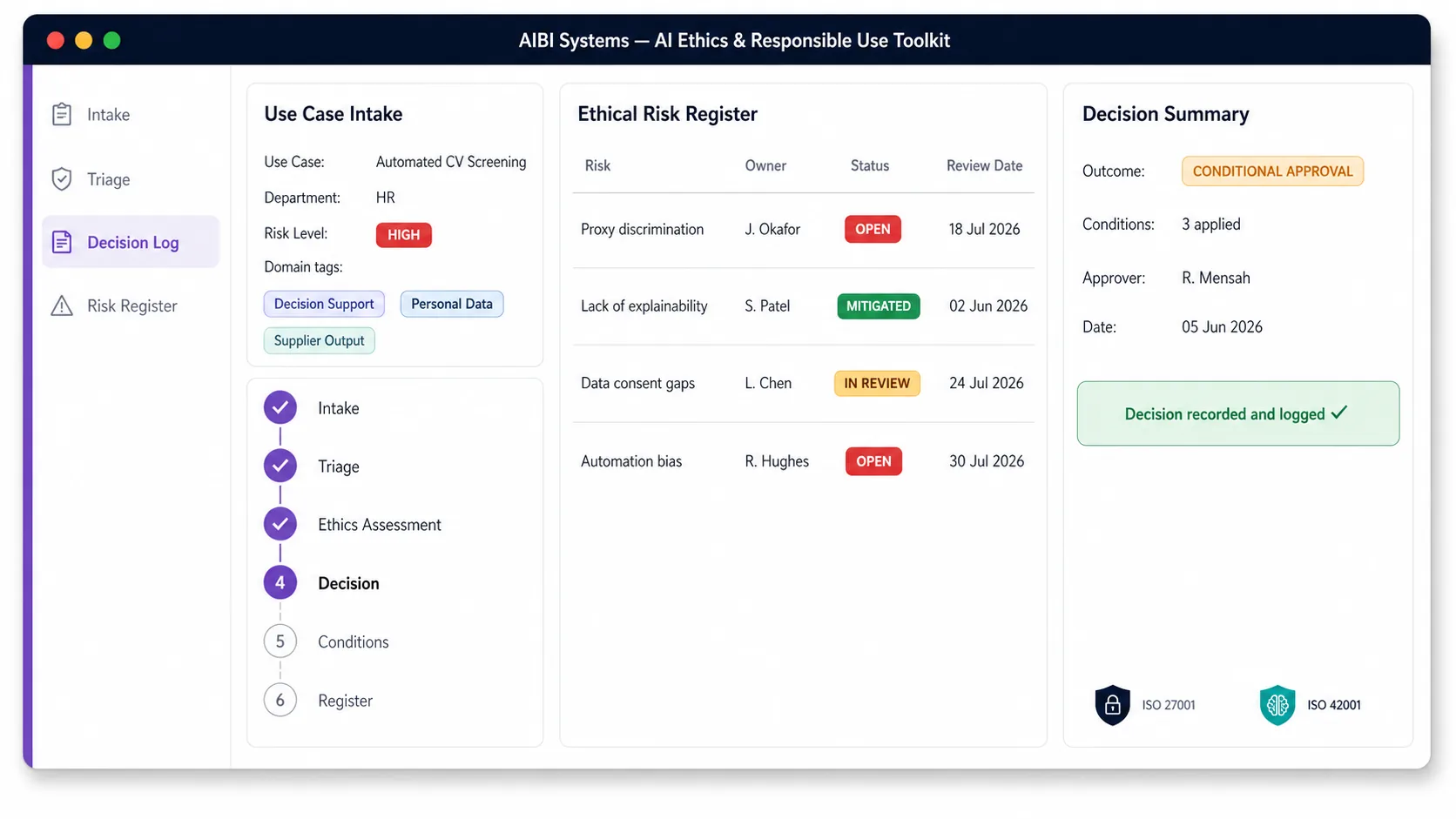
A practical workflow for intake, triage, ethical impact assessment, decision conditions, and a living ethical risk register. Built for real teams who need to show consistent governance under customer, audit, and reputational pressure.
Designed to align with ISO/IEC 42001 intent and integrate cleanly with an ISO/IEC 27001-aligned ISMS approach.
ISO-literate by design - decision discipline, ownership clarity, and audit-friendly evidence outputs.
Available now
Paying by invoice or need a PO raised first? Request an invoice →
We'll send you a proforma invoice within 1 business day. Access is provided once payment clears, using the same automated delivery as a card purchase.
🔒 Secure checkout via Lemon Squeezy ⚡ Instant delivery to your email 📄 7-day refund policy 🧾 Price includes UK VAT 👤 Your governance data stays with you
Outputs may be shared with auditors, customers, regulators, and advisers for assurance.
By the end of today you will have
- A repeatable intake and triage workflow so AI use cases stop being approved informally and inconsistently
- A defensible decision trail - approvals, conditions, owners, and monitoring actions captured in a structured log
- A living ethical risk register with clear treatments, accountability, and evidence prompts
- Customer and vendor assurance outputs you can reuse for RFPs, due diligence, and client assurance requests
Designed for
- CISO and Heads of Risk who need defensible governance without delay
- GRC and InfoSec managers who need a practical, repeatable approval workflow
- AI and Data leads who need guardrails teams will actually follow
- Suppliers under customer assurance pressure to evidence responsible AI controls
- Internal Audit and DPO stakeholders who need traceability and evidence
What this replaces
Most organisations start AI ethics with generic principles, inconsistent approvals, and scattered documents that do not stand up under customer due diligence or internal audit sampling.
When the pressure arrives - an incident, a complaint, a customer questionnaire, or an audit request - teams scramble to reconstruct what happened and why decisions were made.
This toolkit replaces that with one lightweight, repeatable workflow that gives you:
- consistent triage and proportionality
- clear ownership and approval routes
- a structured decision trail with conditions and monitoring actions
- reusable customer and vendor assurance outputs
It is not a certification, audit, or legal assessment. It supports practical, audit-ready governance in day-to-day use, but does not guarantee certification outcomes.
How it works
Run proportionate governance in three levels
Not every AI use case needs a committee. This workflow supports fast reviews for low-risk cases and deeper review where the risk justifies it.
-
Level 1 review - 15 to 30 minutes
Low-risk use cases. Complete intake and triage. Capture decision and owner. -
Level 2 review - 45 to 90 minutes
Medium-risk use cases. Complete ethical impact assessment and decision conditions. Update register. -
Level 3 review - 90 minutes plus
Higher-risk use cases. Deeper assessment, stronger controls, explicit sign-off, and monitoring plan.
Typical format:
- Short working session with the system owner and governance participants
- Evidence prompts captured as you go, not reconstructed later
- Decision conditions recorded so approvals are defensible and repeatable
Keep it alive (ongoing)
The ethical risk register and decision log are designed to be living governance artefacts. You do not rebuild each time. You reuse the same workflow and simply capture what changed.
- Re-run triage when models change, data sources change, or the use case expands
- Use the internal audit checklist to sample decisions and evidence at a practical cadence
- Reuse customer assurance outputs for repeated due diligence requests
Everything included - 11 files
This is a complete responsible use workflow and evidence pack, not a single document: 2 PDF guides, 7 editable Word templates and 2 Excel workbooks.
-
Start Here - Toolkit 3 PDF
Orientation guide for using the toolkit proportionately and consistently.
-
Ethics Risk Register and Decision Log XLSX
Core workflow workbook for intake, triage, decisions, conditions and ethical risk management.
-
Ethical Impact Assessment Template DOCX
Editable assessment template for medium and higher-risk use cases.
-
AI Ethics Governance RACI Template DOCX
Editable RACI clarifying who reviews, approves and owns responsible AI decisions.
-
Customer AI Assurance Summary Template DOCX
Editable customer assurance summary for RFPs and assurance conversations.
-
Vendor Responsible AI Questionnaire DOCX
Editable vendor questionnaire to support responsible AI supply chain assurance.
-
Public AI Ethics & Responsible Use Statement Template DOCX
Editable statement template for publishing a responsible use position.
-
Internal Audit Checklist - AI Ethics & Responsible Use DOCX
Sampling prompts and red flags to test whether decisions are being governed as intended.
-
Integrated RACI XLSX
Workbook view of responsible-use roles and accountabilities across the decision route.
-
Responsible Use Rules - Minimum Baseline DOCX
Editable minimum responsible use baseline for internal adoption.
-
Licence, Use, Refund and IP Terms - Toolkit 3 PDF
Permitted use, restrictions, IP boundaries and the 7-day refund policy.
Sample preview slice
This preview describes the shape of the output without exposing the underlying templates or decision engine.
- Responsible-use triage route with proportionate review thresholds.
- Decision-log structure for approval, conditions, exceptions and ownership.
- Customer assurance summary outline for explaining governance decisions externally.
Outputs and evidence you can generate
- Decision trail per AI use case: approval, conditions, and accountable owner
- Ethical risk register entries with treatments and monitoring actions
- Repeatable triage results that show proportionality and rationale
- Customer assurance summary for consistent external responses
- Vendor questionnaire outputs to support supplier due diligence
- Internal audit sampling evidence and governance gaps identification
Licence summary (plain English)
- Licensed to a single legal entity (the purchasing organisation)
- Authorised users include employees and individual contractors acting on your behalf
- Outputs may be shared with auditors, customers, regulators, and advisers for assurance
- Toolkit files may not be shared, resold, or reused as a commercial method across other organisations
- Access to the toolkit files is provided for the life of the product. We recommend retaining a local copy
When this is not for you
- You want generic AI awareness material or a simple checklist
- You already operate a fully embedded and audited responsible AI governance framework
- You want automated technical tooling rather than a governance-led decision workflow
Procurement justification
This purchase supports implementation of a more operational and evidence-based responsible AI governance process.
The toolkit provides structured review workflows, responsible-use assessment materials, decision records, exception handling and governance artefacts intended to improve consistency, accountability and traceability in AI ethics and responsible-use decisions.
The materials can be used internally by AI governance, product, data, risk, compliance, security and assurance teams to move from high-level principles to recorded decisions for specific AI use cases.
This is a one-off digital toolkit purchase. The supplier does not require access to our AI systems, prompts, models, datasets, source code, customer data, production environments, internal systems, risk registers or completed responsible-use evidence to fulfil this purchase.
The purchase is proportionate because it creates a reusable decision process and evidence trail without requiring a bespoke responsible AI consultancy engagement for every AI use case.
Designed for internal approval and procurement workflows.
Frequently asked questions
Is this aligned with ISO/IEC 42001?
It is designed to align with ISO/IEC 42001 intent and support proportionate AI governance and evidence outputs. It is not a certification assessment.
Is this a certification, audit, or legal assessment?
No. This toolkit supports practical, audit-ready governance and evidence, but it does not provide legal advice and does not guarantee certification outcomes.
How long does a review take?
The workflow supports three levels. A basic review can be completed in 15 to 30 minutes. Medium reviews are typically 45 to 90 minutes. Higher-risk cases may require deeper review and explicit sign-off.
Who should run this internally?
Typically GRC or InfoSec operations runs the workflow, with input from AI and Data leads, and decision sign-off based on your defined RACI and risk level.
Can we share outputs with auditors or customers?
Yes. You may share outputs such as summaries, registers, and decision logs for assurance purposes. The toolkit files themselves must not be shared.
Can we use a consultant or adviser to help run reviews?
Yes. Individual contractors, consultants, or professional advisers may support you as authorised users acting on your behalf. They must not retain copies beyond the engagement.
Is this only for high-risk AI systems?
No. Most organisations need proportionality. This toolkit includes triage so low-risk use cases are not over-governed, while higher-risk cases get deeper review.
Will this help with customer due diligence and RFPs?
Yes. The pack includes a Customer AI Assurance Summary and a Vendor Responsible AI Questionnaire so you can respond consistently and credibly.
How does payment work and who processes it?
Payment is processed securely by Lemon Squeezy, who act as merchant of record for AIBI Systems. Your payment, VAT collection, and any post-sale compliance are handled directly by Lemon Squeezy. Your download link is delivered to your email immediately after payment. All prices shown are inclusive of VAT.
Better value: AI Ethics & Risk bundle
Pair responsible AI decision gates with the unified risk register so ethics decisions become controlled risk actions.
Or get Toolkit 1 through Toolkit 6 in the Complete System Bundle.
Toolkit 3 - AI Ethics & Responsible Use Toolkit
Defensible AI decisions your customers and auditors can trust.
Instant download. One-off purchase. Outputs may be shared with auditors, customers, regulators, and advisers for assurance.